
01Size0.001 fm
Quark
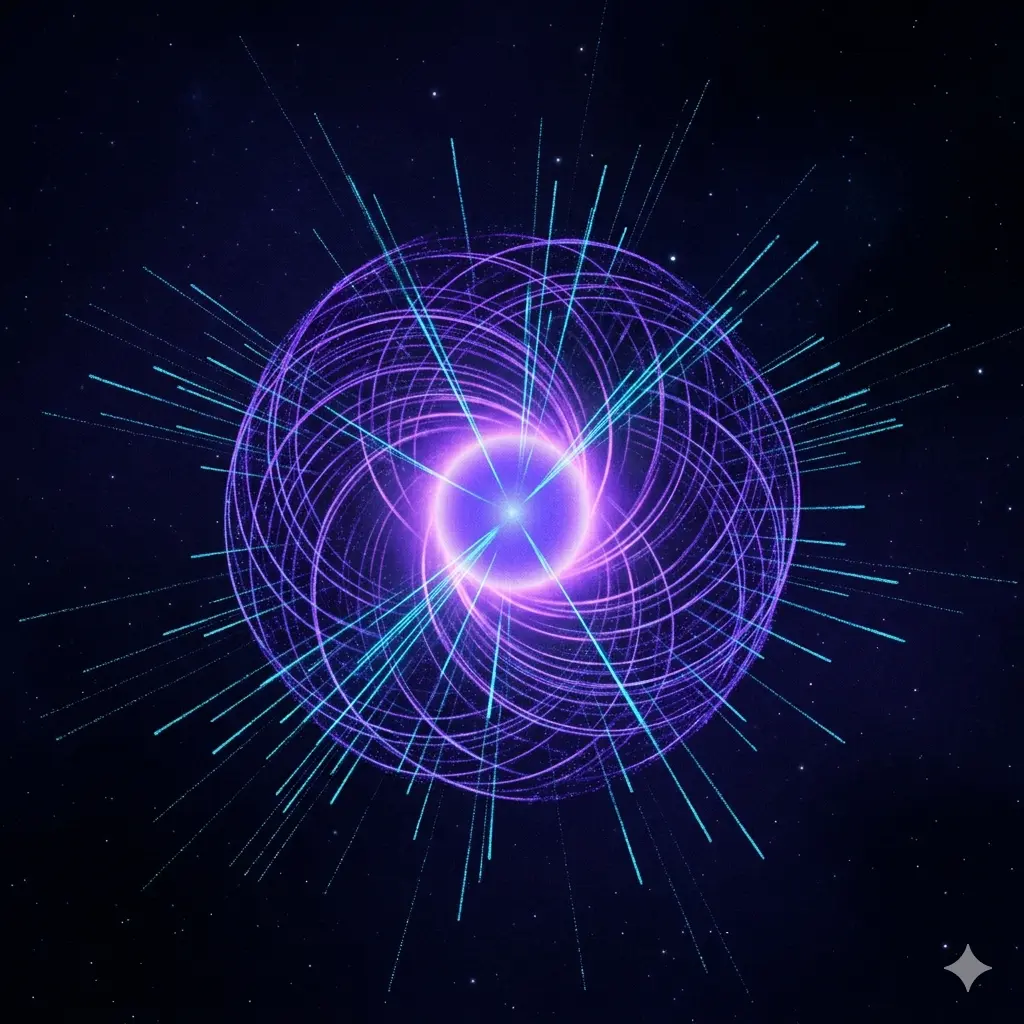
A fundamental building block of matter — with no measurable size at all.
ParticleMicro-World
Loading…
Topics
From cells to quarks to the Planck length — what is really small, what is point-like, and how we can possibly know.
Overview
Ask what the smallest thing in the universe is and the answer depends on what you mean. The smallest living cells are bacteria a few hundred nanometres across. The smallest objects with a measured size are protons and neutrons, under two femtometres wide. The truly fundamental particles — quarks and electrons — have no measured size at all: every experiment so far finds them point-like, and only upper limits exist. Below everything sits the Planck length, a theoretical scale where today's physics stops working. Here is the ladder from top to bottom, with an honest label on each rung.
A human hair is roughly 70 micrometres (µm) thick, close to the smallest detail your eye can make out at reading distance, about 0.1 mm. Below that limit everything is invisible without help. A human red blood cell is about 8 µm across, and a typical animal cell 10 to 30 µm. Most bacteria are 0.5 to 5 µm long, and the smallest are only about 0.2 to 0.3 µm — 200 to 300 nanometres (nm). Viruses are smaller still: most measure 20 to 300 nm, and the smallest known, such as circoviruses, are under 20 nm. There are exceptions in both directions. Giant viruses like Pithovirus reach about 1.5 µm, bigger than many bacteria, while the bacterium Thiomargarita magnifica grows up to about 2 cm long — visible to the naked eye. Smaller than any virus, the DNA double helix inside your cells is about 2 nm wide.
Atoms are where chemistry lives. They range from about 0.1 nm across for hydrogen to around half a nanometre for the largest — so somewhere between half a million and a million atoms side by side would span the thickness of a human hair. Almost all of an atom is empty space. Its nucleus is 10,000 to 100,000 times smaller than the atom itself: blow an atom up to the size of a football stadium and the nucleus would be about the size of a pea on the centre spot, holding more than 99.9% of the mass. The nucleus is made of protons and neutrons. A proton's charge radius is about 0.84 femtometres (0.84 × 10⁻¹⁵ m), making it about 1.7 fm across. Even that figure took effort: in 2010, measurements using muonic hydrogen gave a value about 4% smaller than the older accepted one, the so-called proton radius puzzle. Later experiments have mostly converged on the smaller value. Note that a proton has no hard surface; its "size" is the extent of its electric charge, which fades out gradually.
Protons and neutrons are each made of three quarks, and atoms are completed by electrons. As far as anyone can tell, both quarks and electrons are point particles: they show no internal structure and no measurable size. That is not the same as proving their size is zero — it means every experiment so far has come up empty. At the HERA electron–proton collider in Hamburg, the ZEUS experiment set an upper limit of 0.43 × 10⁻¹⁸ m on the radius of a quark (published 2016), about 2,000 times smaller than a proton's radius. Electrons have been tested to similar or finer levels without any sign of structure. On this site, the quark stop's figure of 10⁻¹⁸ m is such an upper bound, not a measured diameter. If you measure smallness by mass instead, the champions are neutrinos: the KATRIN experiment has shown that a neutrino weighs less than 0.45 eV, under a millionth of an electron's mass. Photons and gluons have no mass at all.
The Planck length, about 1.6 × 10⁻³⁵ m, is built from three constants of nature: the speed of light, the gravitational constant and Planck's constant. It is about 10²⁰ times smaller than a proton — roughly as much smaller than a proton as Earth is smaller than the observable universe. Physicists expect that at around this scale the quantum effects of gravity become important, and that general relativity and quantum mechanics, as we currently write them, stop giving trustworthy answers. It is often described as the "pixel size" of the universe or the smallest length that can exist. That claim goes beyond the evidence. No experiment has shown that space is grainy; some approaches to quantum gravity, such as loop quantum gravity, suggest a discrete structure near this scale, while others do not. Observations of distant gamma-ray bursts have searched for the tiny differences in the speed of light that the simplest grainy-space models predict, and so far have ruled several of them out. Our most powerful colliders probe distances down to roughly 10⁻¹⁹ m — still several million billion times larger than the Planck length.
Each step down the scale needs a new tool. The naked eye resolves about 0.1 mm. Ordinary light microscopes are limited by the wavelength of light to about 200 nm — enough to see bacteria, but not most viruses — although super-resolution fluorescence methods, honoured with the 2014 Nobel Prize in Chemistry, push that to tens of nanometres. Electron microscopes use electrons, whose wavelength is far shorter, and the best modern instruments resolve detail finer than 0.1 nm: individual atoms. The scanning tunnelling microscope, invented in 1981 by Gerd Binnig and Heinrich Rohrer, maps single atoms on a surface by feeling them with a sharp tip. Below the atom, nothing can be photographed; sizes are inferred from scattering — firing particles at a target and studying how they bounce. Rutherford found the atomic nucleus this way in 1911 from gold-foil experiments, and Robert Hofstadter used electron scattering in the 1950s to measure the size of the proton. Today's colliders follow the same logic: the higher the energy, the shorter the wavelength, and the finer the detail they can resolve.
A fundamental building block of matter — with no measurable size at all.
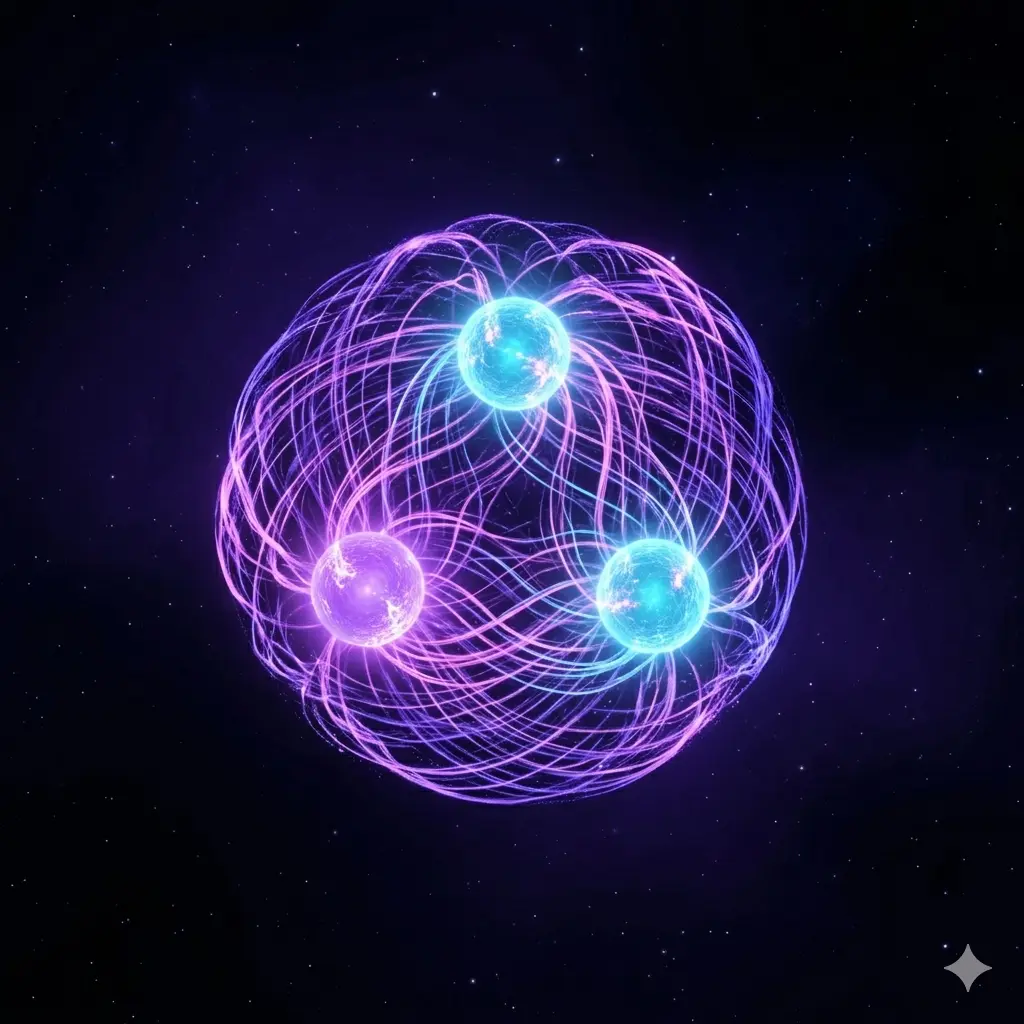
Three quarks bound into one of nature's most stable forms.
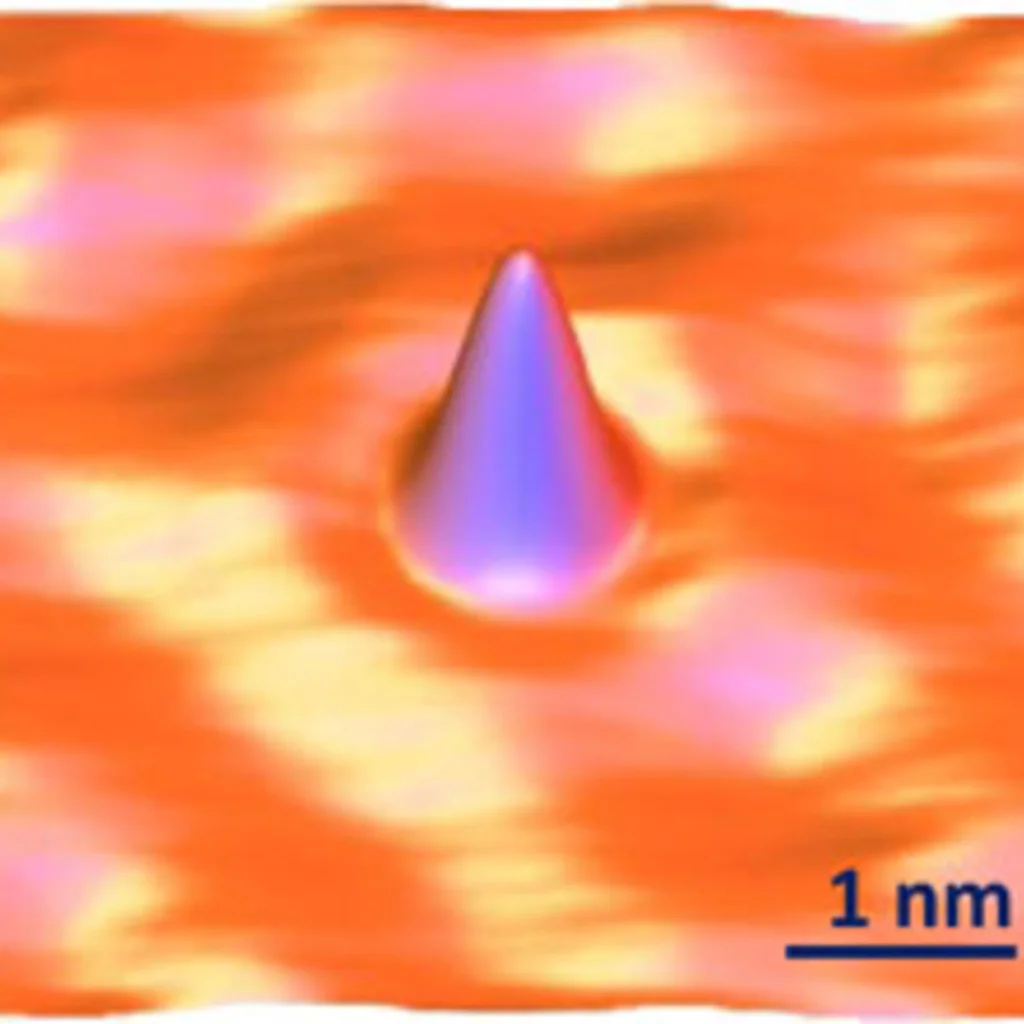
The smallest piece of any chemical element.
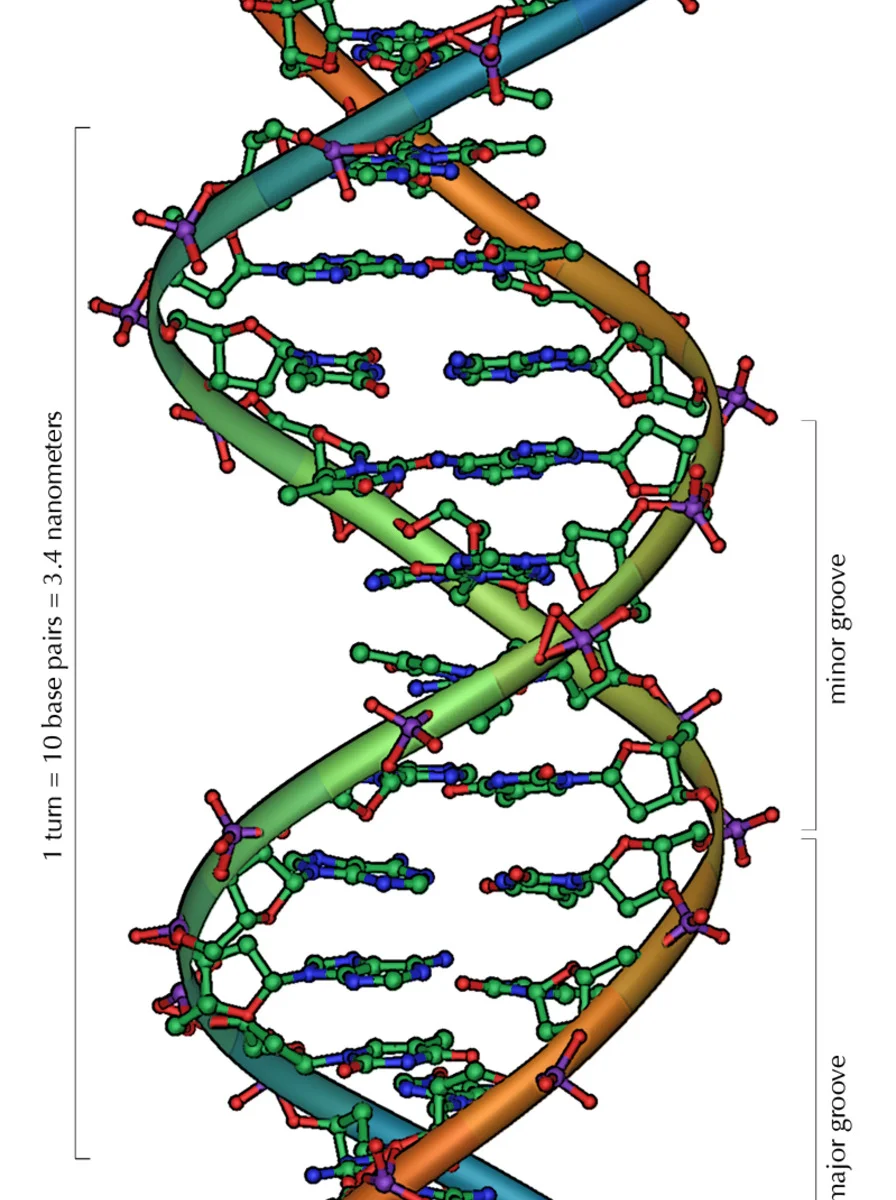
The instruction book that builds you — and nearly every other living thing.
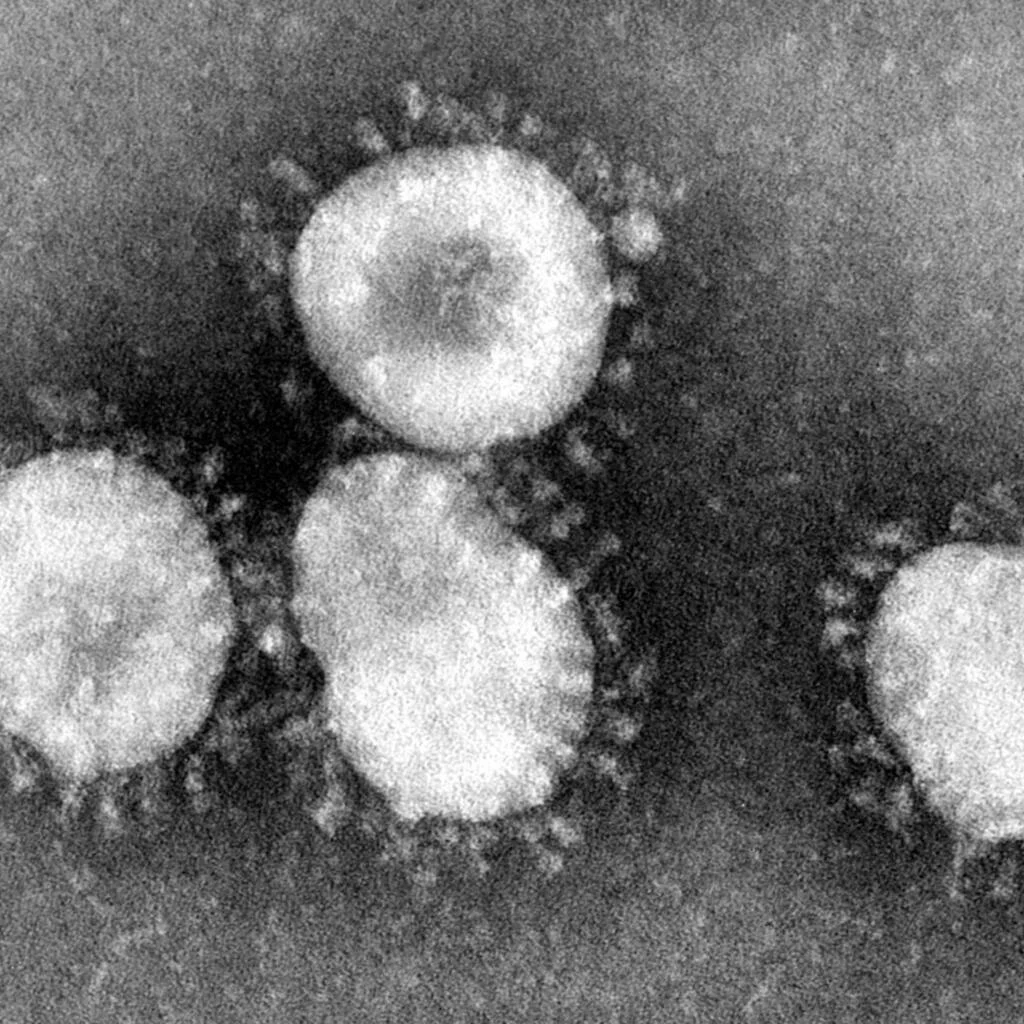
Strands of code wrapped in protein.
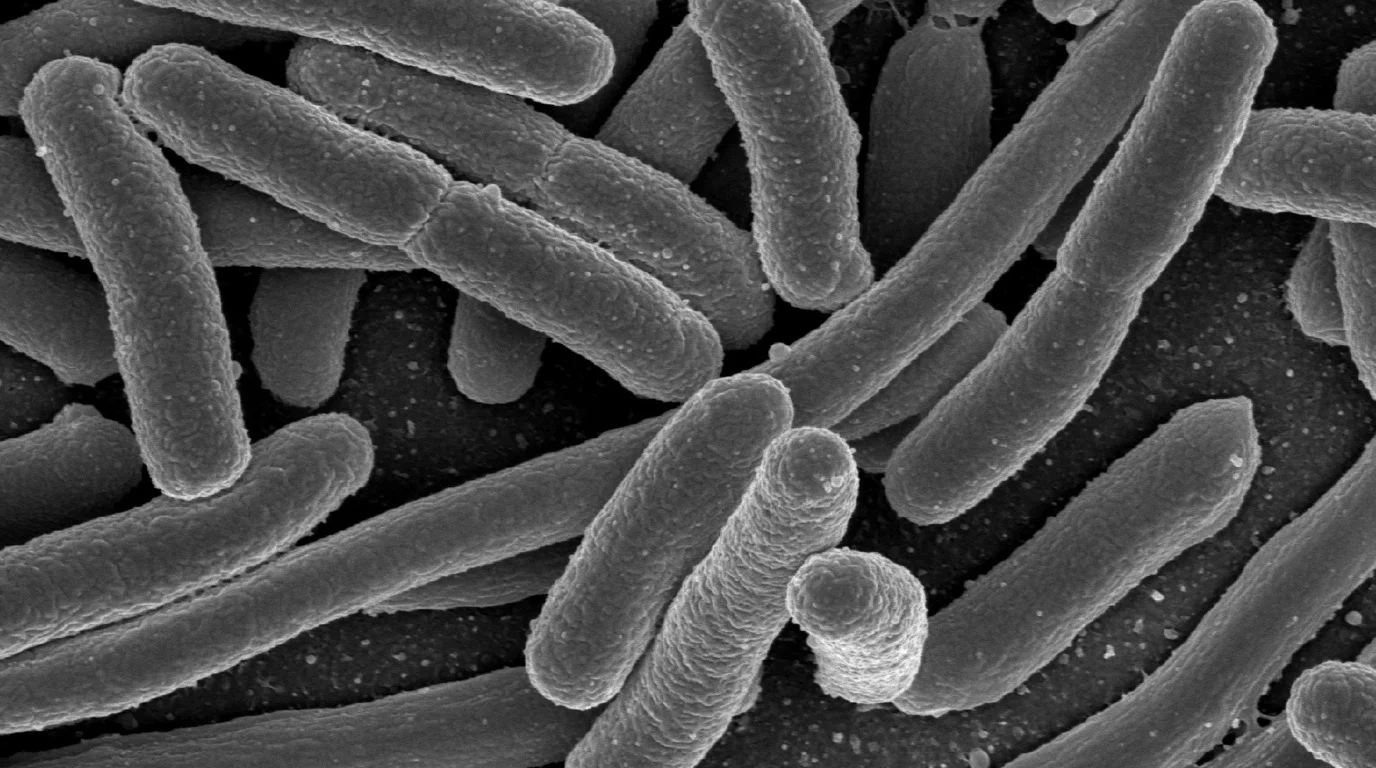
Single-celled life, no nucleus required.
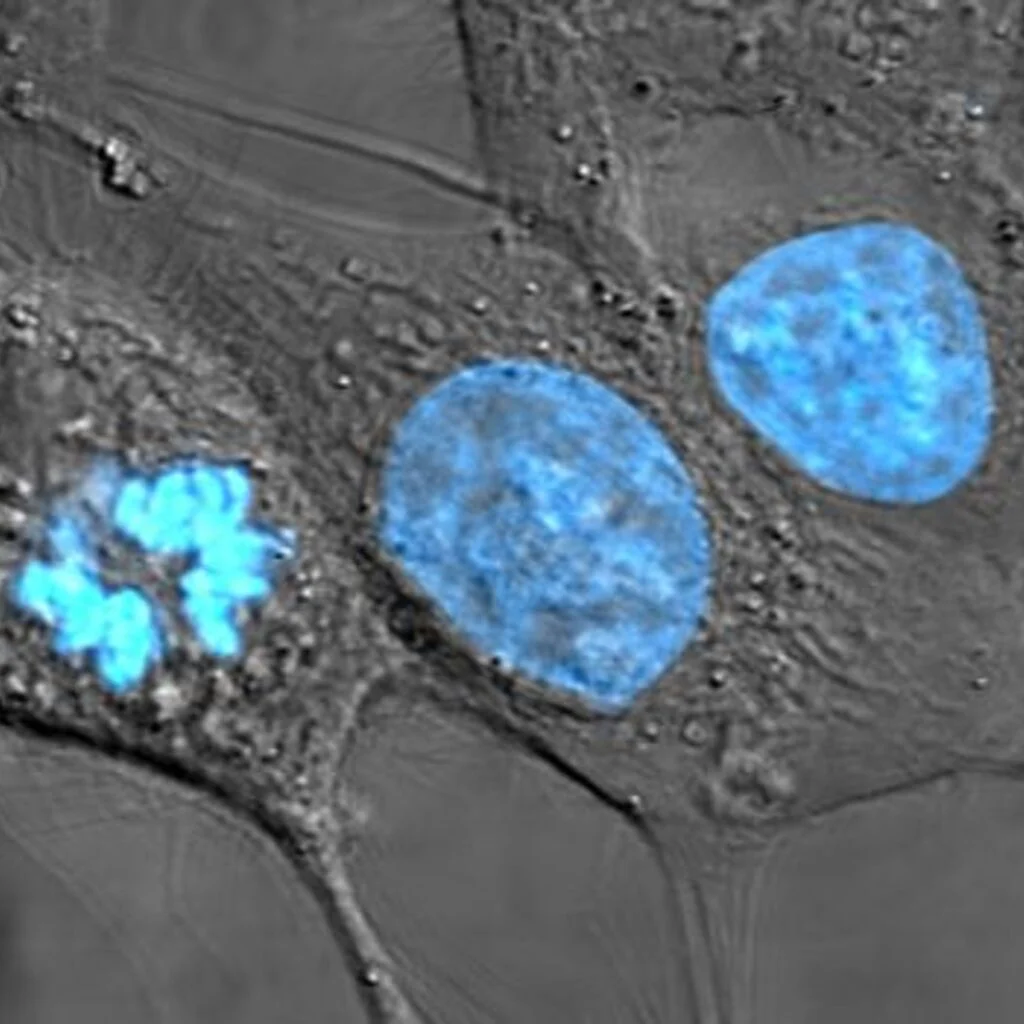
The smallest unit of life.
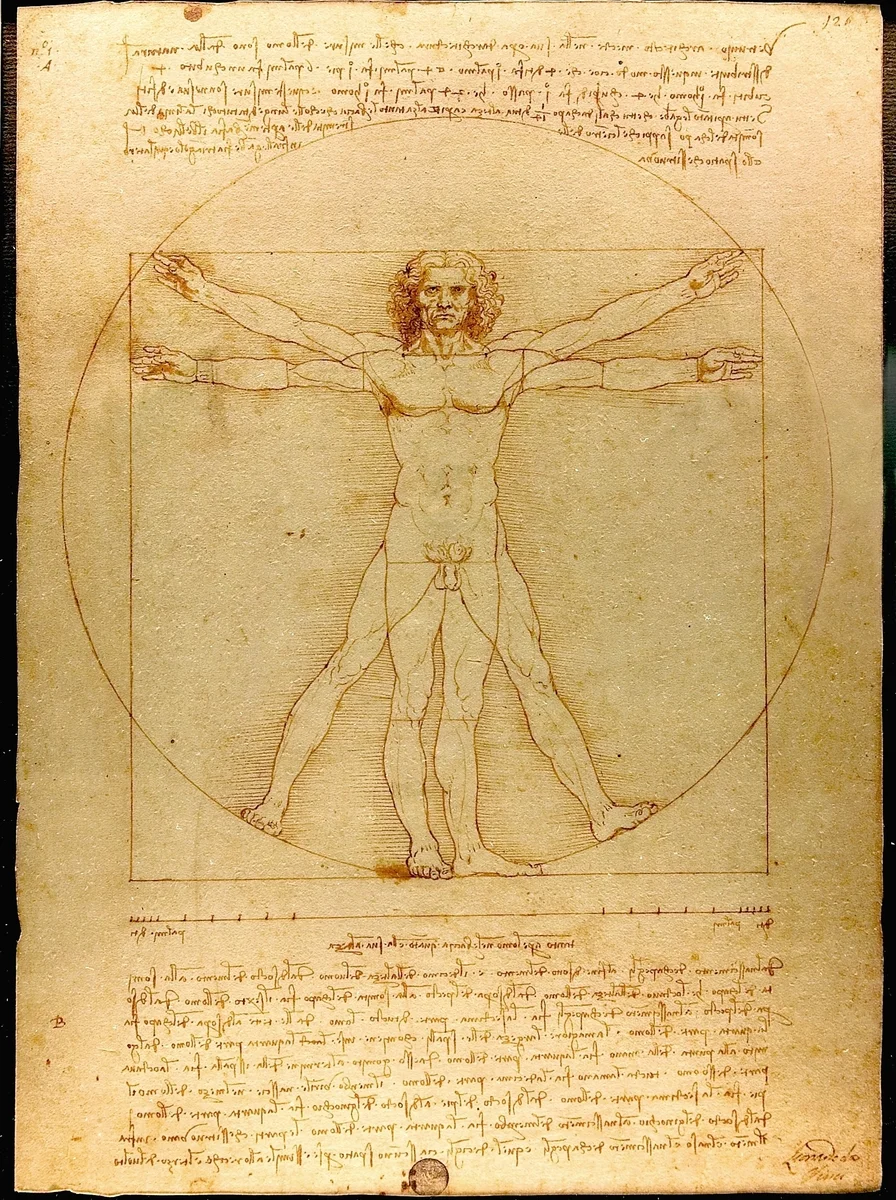
Halfway between the smallest and the largest — on a logarithmic scale.