01Size93.0 billion lyDist46.5 billion ly
Observable Universe
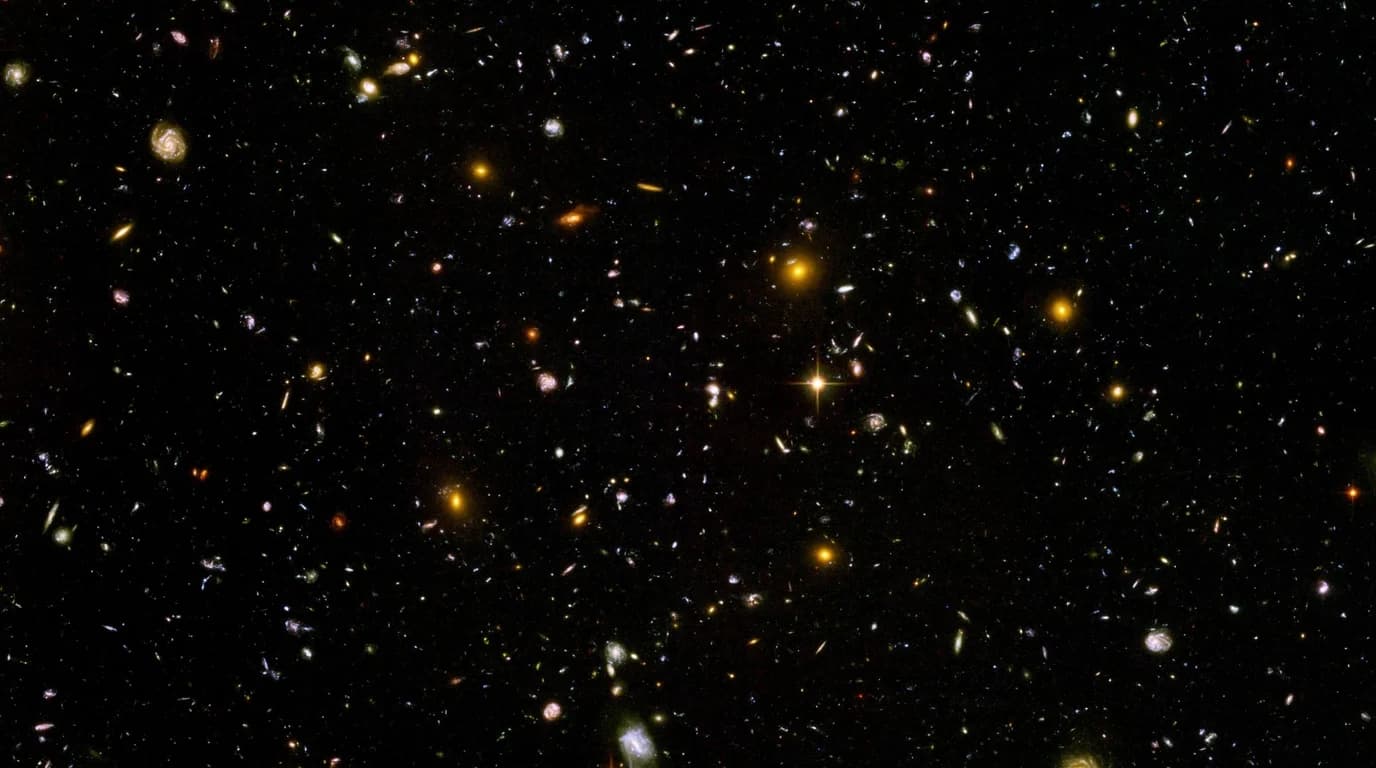
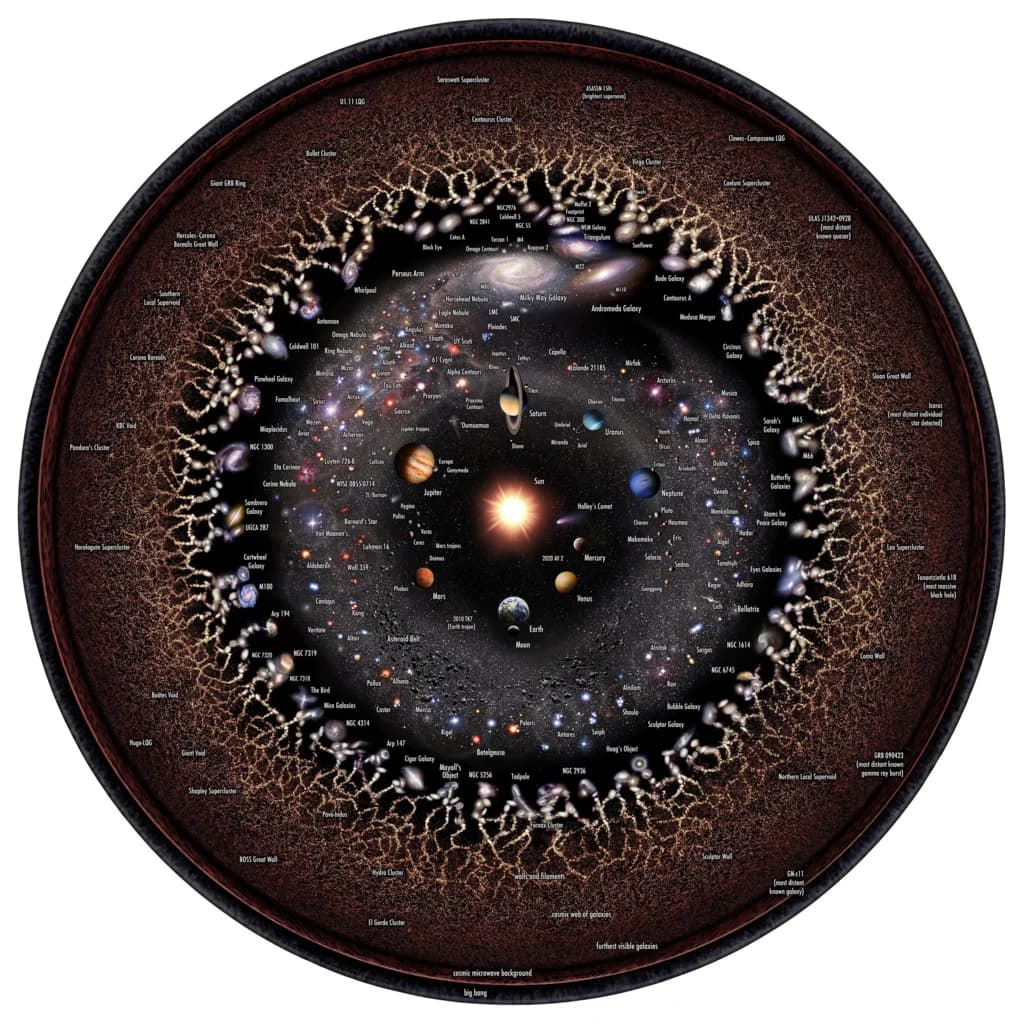
The 93-billion-light-year sphere we can, in principle, see.
CosmosCosmos
Loading…
Topics
The hot, dense origin of the universe we can see.
Overview
Our best current picture of cosmic history says that around 13.8 billion years ago, everything in the observable universe was packed into a state so hot and dense that ordinary matter, light and space behaved in ways our theories can no longer fully describe. From that state — call it the Big Bang — space expanded, cooled, and produced the matter, stars and galaxies we observe today. The Big Bang is not an explosion *inside* space; it is the expansion *of* space itself.
In the 1920s Edwin Hubble showed that distant galaxies are receding from us, and the further away they are, the faster they recede. This is the strongest direct evidence for cosmic expansion. We are not at any special centre — every galaxy sees this same outward flow from every other galaxy. Run the expansion backwards in time and everything collapses to a single hot dense state.
About 380,000 years after the Big Bang, space cooled enough for atoms to form and light to travel freely for the first time. That ancient light, redshifted into microwaves by 13.8 billion years of expansion, now bathes the entire sky in a faint, almost-uniform glow. Tiny temperature variations across this Cosmic Microwave Background map the seeds of every galaxy that exists today. We have measured it with extraordinary precision — it is among the best-tested predictions in all of physics.
In 1998, two independent teams measuring distant supernovae found that the universe's expansion isn't slowing down (as gravity would suggest) — it's speeding up. A mysterious form of energy embedded in space itself, called *dark energy*, appears to be pushing space apart faster and faster. Over the next hundred billion years, this acceleration will eventually carry every galaxy outside our local group beyond the cosmic horizon. The acceleration is **established theory**; what dark energy actually *is* remains a deep open question.
Asking "what happened before the Big Bang?" sits at the very edge of physics. Several ideas exist — eternal inflation, where our universe is one of many bubbles in a much larger inflating multiverse; cyclic models, where Big Bangs and Big Crunches repeat; bouncing models from loop quantum gravity. None has been observationally confirmed; some may even be unconfirmable in principle. **This entire area is speculative** — fascinating, but not yet science the way the rest of this page is.