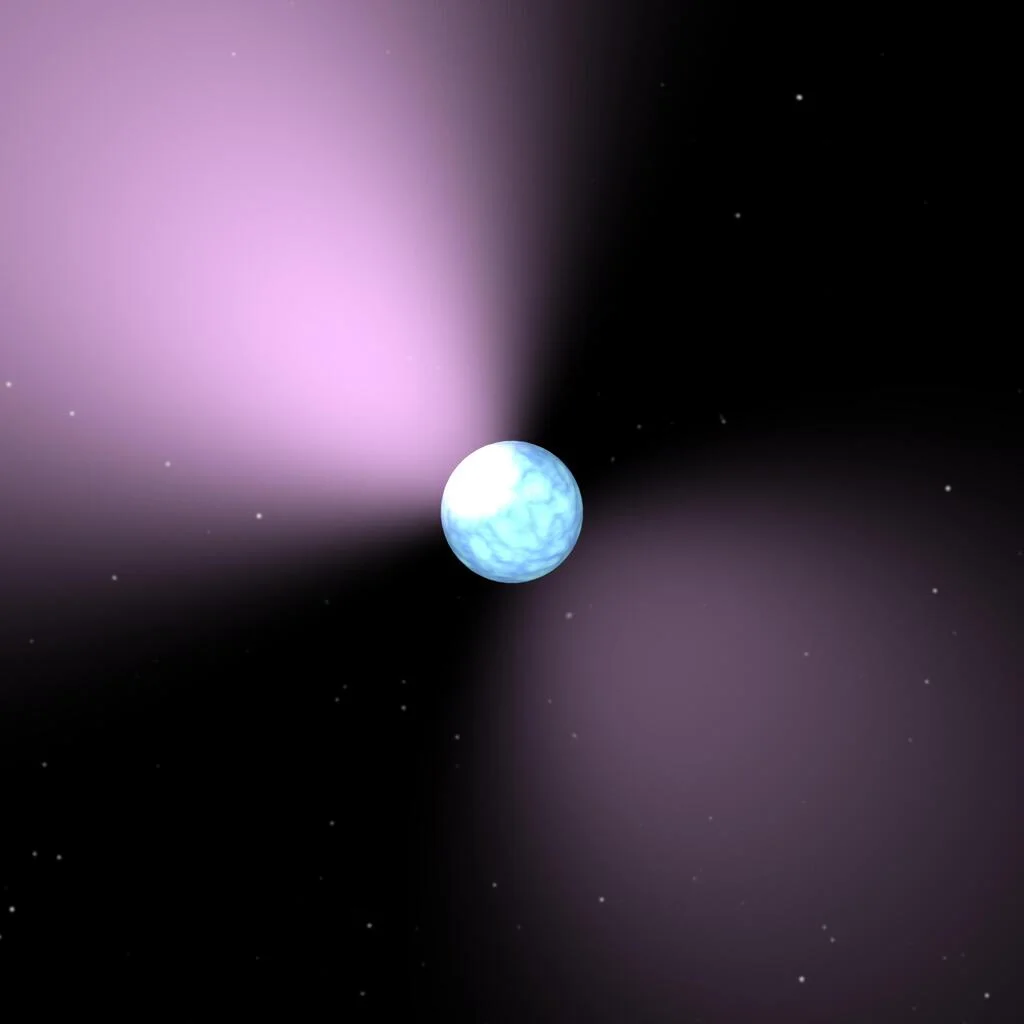
01Size20 kmTemp600,000 K (≈ 599,700 °C)
Neutron Star
A city-sized star with the mass of a sun.
StarStellar remnantCosmos
Loading…
Topics
Regions of spacetime nothing can escape.
Overview
A black hole is a region where matter has collapsed into a gravitational well so deep that not even light moving at the cosmic speed limit can climb back out. Once you cross its event horizon, you're committed. We can't see inside one directly — we infer their existence from how they bend light, swallow gas, and tug on the stars around them.
Black holes come in three rough size classes. Stellar-mass black holes weigh 3 to a few tens of solar masses and form when massive stars die. Intermediate-mass black holes — hundreds to hundreds of thousands of solar masses — were long theorised and only recently confirmed in a handful of specific systems. Supermassive black holes, millions to tens of billions of solar masses, sit at the centres of almost every large galaxy. How the supermassive ones grew so fast in the early universe is still an open question.
What a dying star leaves behind depends on its mass. Sun-sized stars end as cooling white dwarfs. Stars 8 to 25 times the Sun's mass collapse into neutron stars after their supernova. Only the heaviest stars — those above roughly 25 solar masses — collapse straight into stellar-mass black holes. Black holes are, in this sense, the graveyards of the most massive stars.
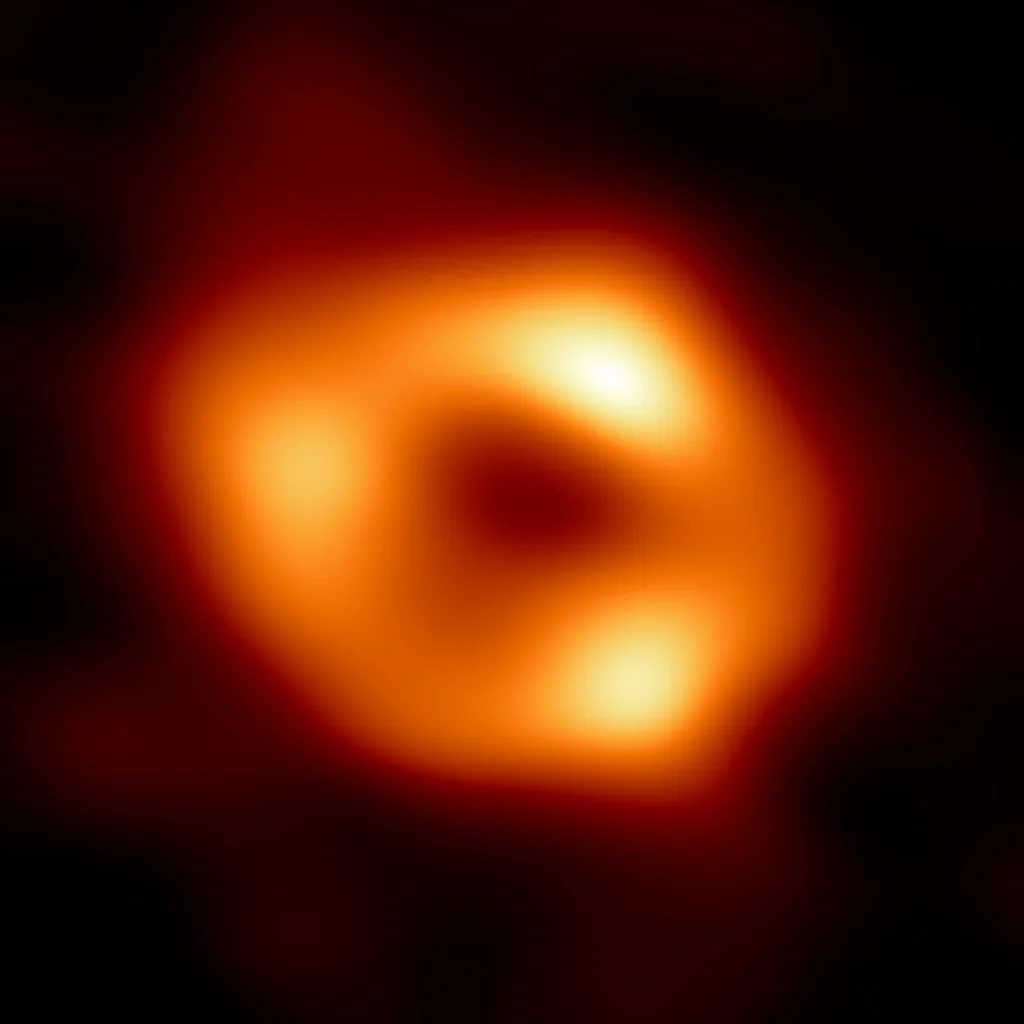
Sagittarius A* weighs about 4.15 million solar masses and sits at the centre of the Milky Way; we got its first direct image in 2022. M87* in the galaxy M87 is much heavier — around 6.5 billion solar masses — and was the very first black hole ever imaged, in 2019. TON 618 and Phoenix-A are contenders for the most massive known, each tens of billions of solar masses. Gaia BH1 is the nearest known black hole of any kind — a much smaller stellar-mass one only 1,560 light-years away.
Past the event horizon, our current theories run out. General relativity predicts a "singularity" — a point of infinite density — at the centre of every black hole. But infinities in physics are usually a sign that the theory is incomplete, not a real prediction. A future theory of quantum gravity, when we have one, will probably replace the singularity with something less infinite.
Stephen Hawking showed in 1974 that black holes are not actually perfectly black — they radiate a tiny amount of thermal energy from just outside their event horizon. Over inconceivably long timescales (around 10⁶⁷ years for a stellar-mass black hole, far longer for supermassive ones) they should slowly evaporate. We have never observed this happen — it's far too faint.