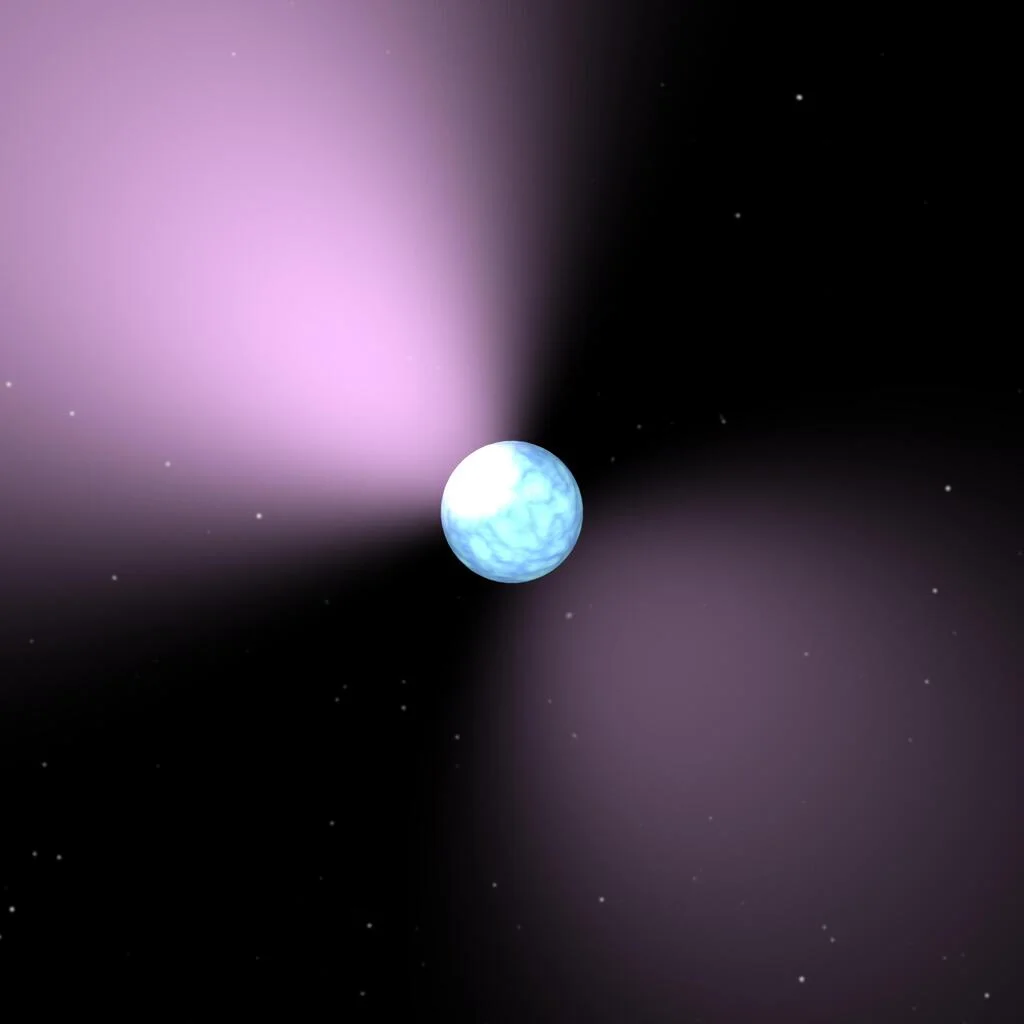
01Size20 kmTemp600,000 K (≈ 599,700 °C)
Neutron Star
A city-sized star with the mass of a sun.
StarStellar remnantCosmos
Loading…
Topics
How massive stars die — and what they leave behind.
Overview
A supernova is the explosive death of a star, which can briefly outshine an entire galaxy. The explosion seeds the universe with heavy elements — much of the matter in your body heavier than helium was forged inside stars and scattered by events like this. Telescopes now catch thousands of supernovae a year in other galaxies, but in our own Milky Way one occurs only every century or so.
Astronomers see two main flavours. **Core-collapse supernovae** (Types II, Ib, Ic) happen when a star above about 8 solar masses runs out of nuclear fuel — its core collapses in a fraction of a second, then rebounds, blowing the outer layers off. **Thermonuclear supernovae** (Type Ia) happen when a white dwarf in a binary system accretes enough matter to ignite runaway carbon fusion, vaporising the entire star. The latter are so consistent in brightness they're used as standard candles to measure cosmic distances.
If the dying star was 8–25 solar masses, its collapsed core remains as a neutron star — a city-sized object as heavy as the Sun. If above ~25 solar masses, the collapse goes further and a stellar-mass black hole is left in the centre. The outer layers expand as a glowing supernova remnant — the Crab Nebula is the most famous, the visible debris of a supernova humans on Earth recorded in 1054 CE.
**SN 1054** — recorded by Chinese, Japanese and Arab astronomers in July 1054 CE — produced the Crab Nebula and its central pulsar. **SN 1572** was observed by Tycho Brahe and broke the medieval belief in an unchanging cosmos. **SN 1987A**, in the Large Magellanic Cloud, was the closest naked-eye supernova in nearly 400 years and the first whose pre-explosion star was identified.
Hydrogen and helium come from the Big Bang. Almost everything else — carbon, oxygen, calcium, iron, gold, uranium — is forged either inside stars or in supernovae and neutron-star mergers. Carl Sagan's line that "we are made of star-stuff" is literally true: every atom in your body heavier than helium was forged inside an ancient star and scattered across space when it died. You are, structurally, recycled supernova.