01Size24.0 million kmDist26,002 ly
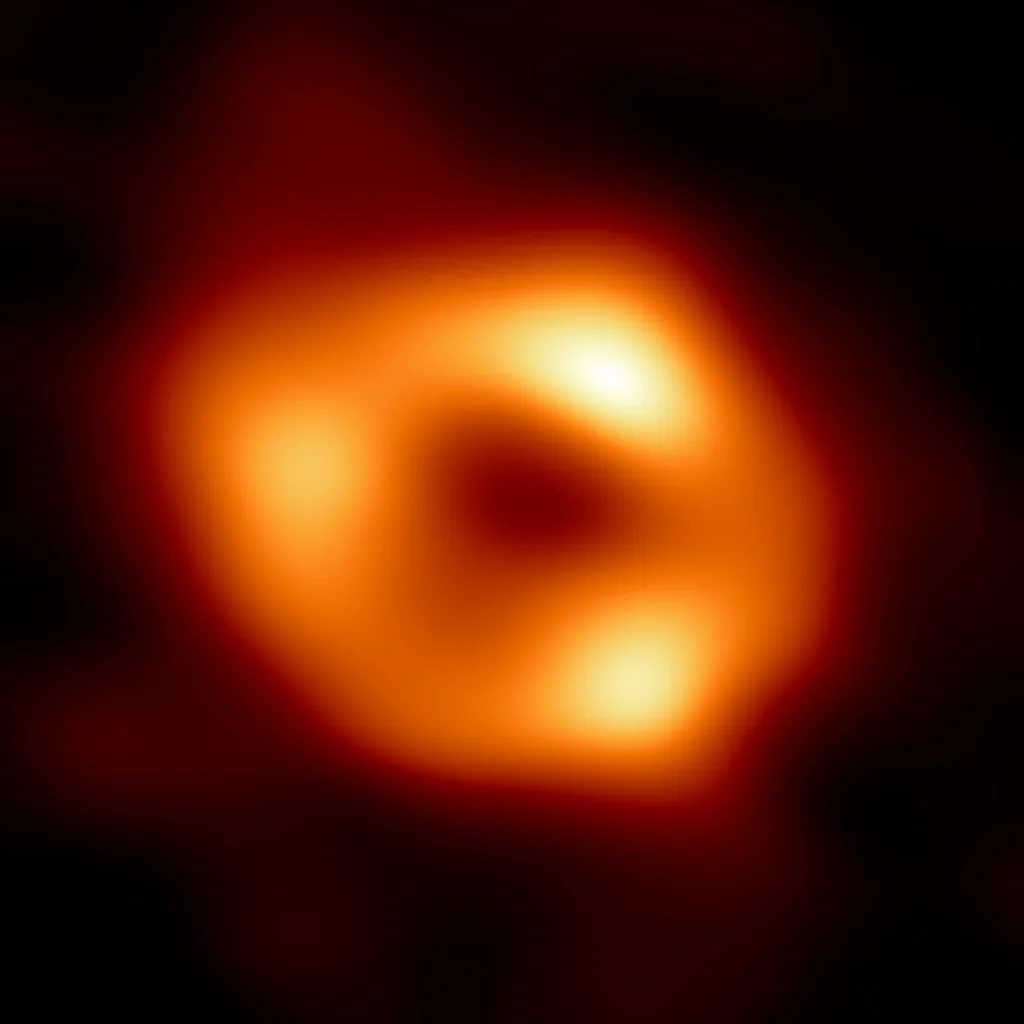
Sagittarius A*
The supermassive black hole at the heart of our galaxy — and its more extreme cousins.
Black holeCosmos
Loading…
Topics
Not as universal as it feels.
Overview
Newton thought time flowed at the same rate everywhere. Einstein showed otherwise. Time runs slower when you move fast, and slower deep inside a gravitational well. The effects are tiny in everyday life but real, measurable, and built into the satellites in your phone's GPS chip. This page sticks to the parts that are **established theory** — well-tested for over a century.
Einstein's 1905 special theory of relativity says that two observers moving relative to each other will disagree about how much time has passed between two events. Specifically: a clock moving past you ticks slower than your own. The effect is real but tiny at everyday speeds. At 1% of the speed of light a clock runs about 0.005% slow. At 99% it runs **seven times** slower. This isn't an illusion — it's been measured directly with atomic clocks on fast aircraft. **Status: established theory, verified repeatedly.**
Einstein's 1915 general theory of relativity says gravity also slows time. A clock at sea level ticks slightly slower than a clock at the top of Mount Everest. A clock just outside a black hole's event horizon would tick arbitrarily slowly compared to ours. The effect is tiny on Earth but huge near a black hole — and significant enough that GPS satellites have to correct their clocks by 38 microseconds per day, or your phone's location would drift by kilometres every hour. **Status: established theory, again verified directly.**
If one twin stays on Earth and the other accelerates to near light-speed, travels to a distant star, and returns — the travelling twin will be younger. This isn't a paradox; the asymmetry comes from acceleration, which only the travelling twin experiences. The effect has been measured with atomic clocks flown around the world. **Status: real consequence of relativity, observationally confirmed.**
Why does time only move forwards? Physically, almost every law of physics works the same backwards as forwards — except the second law of thermodynamics, which says total entropy (disorder) always increases. That asymmetry is what gives time its direction. Why the universe started in such a low-entropy state, though, is a much harder question — and an open one. **Status: the arrow itself is established; its ultimate origin is speculative.**